Why Cloud-Routed Access Creates Unnecessary Exposure
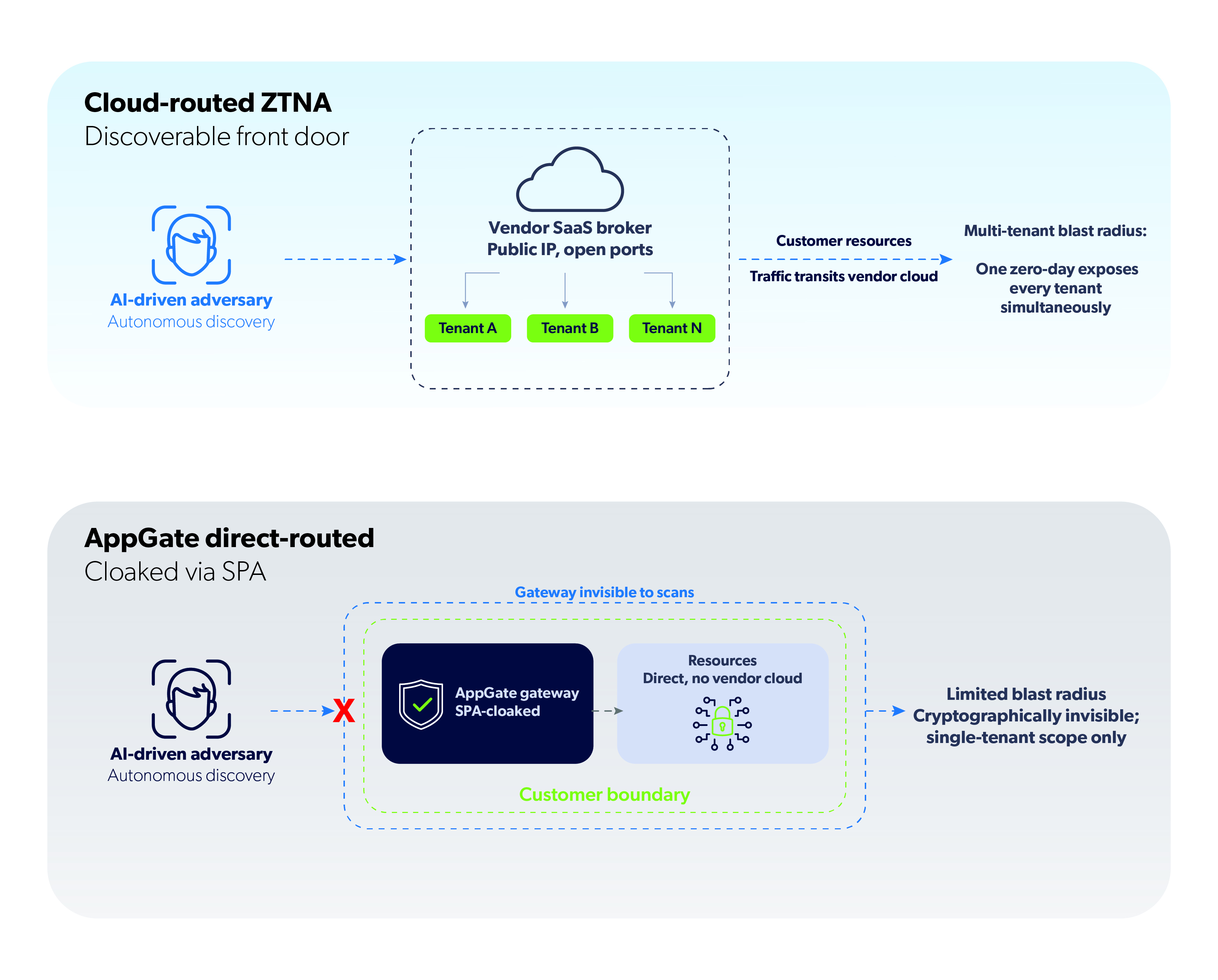
Many modern Zero Trust Network Access (ZTNA) and secure-access-service-edge (SASE) offerings depend on a vendor-operated, multi-tenant cloud broker in the traffic path. The downside of these models is that the services must stay publicly reachable to deliver value. In an era of autonomous reconnaissance and accelerated exploitation, this increases vulnerability risks.
When a cloud-delivered broker becomes the front door for many customers at once, a single vulnerability can have broad consequences. That is especially relevant for federal agencies, where uptime, resilience, and control are mission requirements—not nice-to-haves. Recent industry disclosures involving authentication bypass, remote code execution, and denial-of-service flaws across remote access platforms show exactly why shared exposure deserves closer scrutiny.
AppGate’s Approach: Direct-routed, cloaked, and mission-ready
AppGate ZTNA is built around a different architectural model. Instead of forcing federal traffic through a vendor cloud, AppGate ZTNA enables direct-routed connections and keeps enforcement inside the customer boundary. Combined with Single Packet Authorization (SPA), this approach helps agencies reduce the exposed attack surface while maintaining the control, performance, and deployment flexibility that modern federal environments demand.
That distinction matters. AppGate ZTNA gateways are designed to remain invisible to unauthorized scanning and automated discovery until a valid SPA packet is presented. For defenders facing AI-augmented reconnaissance, reducing discoverability is a powerful advantage: attackers cannot easily target what they cannot see.
See the Difference: Cloud-routed ZTNA vs. AppGate’s direct-routed model
What Federal Teams Gain with AppGate ZTNA
A cloaked attack surface. AppGate ZTNA uses SPA to keep gateways hidden from unauthorized port scans, reconnaissance, and automated discovery. For agencies concerned about machine-speed targeting, reducing visibility at the network layer can materially lower exposure before an attack ever begins.
More control and less shared-service blast radius. Because AppGate ZTNA is deployed within the customer boundary rather than as a publicly shared cloud broker, agencies retain greater control over where policy is enforced and how access is delivered. AppGate ZTNA helps contain risk and aligns with federal expectations for operational ownership.
Direct-routed performance. By avoiding unnecessary cloud backhaul, AppGate ZTNA helps keep traffic paths efficient and supports low-latency access to mission-critical resources. The result is a Zero Trust approach designed for both stronger security and better user experience.
Adaptive policy based on identity, device and context. AppGate ZTNA continuously evaluates multiple signals—not just a user login—to help agencies make more informed access decisions in real time. That supports a more dynamic Zero Trust posture as conditions change.
Precise access through microsegmentation. AppGate supports segments-of-one so users, devices, and workloads can be connected only to the specific resources they are authorized to reach. That helps limit lateral movement and reduces the impact of compromise.
Coverage for real-world federal environments. AppGate ZTNA is built to support more than simple user-to-app scenarios, helping agencies extend Zero Trust principles across diverse protocols, legacy systems and operational technologies that often fall outside conventional access models.
Support for tactical edge and DDIL operations. Federal missions do not always happen in ideal network conditions. AppGate ZTNA is designed to support disconnected, intermittent, and limited-bandwidth environments, helping teams maintain secure access even when connectivity is constrained.
Federal proof points that matter. App Gate ZTNA is NIAP Protection Profile approved, Common Criteria Certified, FIPS 140-3 Validated, DISA Category Assurance List (CAL) approved, CNSA 2.0 (in process). AppGate ZTNA also has DOW ATOs spanning IL2 through IL6+ across NIPR, SIPR, and TS networks, and is operational across Air Force, Army, Navy, Marine Corps, Space Force, and U.S. Cyber Command with associated Approved Product Listings (APL).
The Bottom Line
As AI-augmented threats continue to compress attack timelines, federal agencies need more than incremental improvements to remote access. They need an architecture designed to reduce exposure from the start. AppGate ZTNA gives federal mission owners a direct-routed, cloaked approach to Zero Trust that supports security, resilience, and operational control across hybrid, classified, and tactical environments.
Learn more about AppGate’s ZTNA for federal agencies at appgate.com/federal-division.